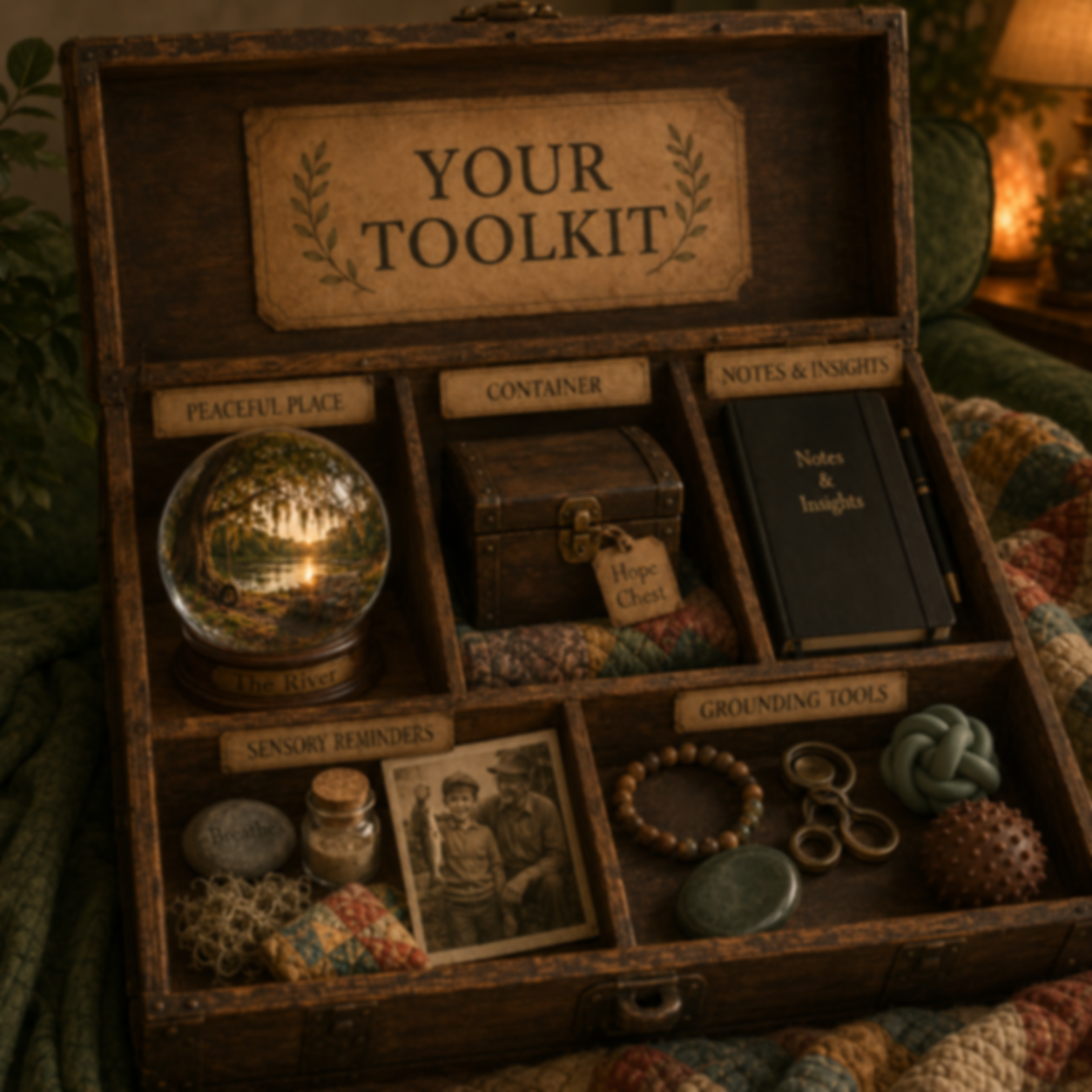
Part One: Your Peaceful Place

What is a Peaceful Place?
A Peaceful Place is an imagined environment that helps your mind and body access a sense of:
Safety
Security
Comfort
Peace
Support
Calm or steadiness
It may be somewhere you have visited, a combination of several places, or somewhere that could never exist in real life. It could be a room inside a tree, a cabin floating among the stars, a warm cave beside the ocean, a library beneath a mountain, or anything else your mind creates.
The goal is not to build the “perfect” place. The goal is to create a place that produces a noticeable positive shift in your present experience. Imagining a calm place is used in EMDR preparation as a self-regulation resource.
A Few Guidelines
Your Peaceful Place should feel:
Safe and secure
Comfortable
Peaceful or regulating
People are usually not included because even loved and trusted people can bring complicated feelings, expectations, memories, or worries into the scene.
Pets and animals are welcome if their presence feels comforting.
You may also include reminders of important people, such as:
A quilt made by a loving grandmother
A favorite photograph
A letter, recipe card, piece of jewelry, or craft
A familiar chair
A symbolic light, object, or token
A scent or sound associated with being cared for
You remain completely in charge of this place. No one can enter unless you deliberately allow it.
Step 1: Choose or Create the Setting
Allow an image, feeling, or idea of a peaceful place to begin forming.
It does not need to appear all at once.
Where are you?
Are you:
Indoors or outdoors?
Near water, mountains, trees, fields, firelight, snow, or stars?
In a small enclosed space or somewhere wide and open?
On the ground, above the ground, underground, underwater, or somewhere imaginary?
In a familiar place or somewhere entirely new?
How are you situated?
Are you:
Sitting, lying down, standing, floating, swinging, or walking?
Wrapped in something?
Supported by a chair, bed, hammock, moss, water, clouds, or something else?
Near a wall, beneath a roof, inside a boundary, or surrounded by open space?
Notice what position allows your body to feel most protected and comfortable.
What time is it?
Consider:
The time of day
The season
The temperature
The weather
The amount and quality of light
Is it early morning, golden hour, nighttime, or a time that does not exist anywhere else?
What are you wearing?
Imagine clothing that fits the environment and feels right on your body.
It may be:
Soft
Warm
Cool
Loose
Weighted
Protective
Familiar
Completely imaginary
You can also imagine shoes, bare feet, blankets, armor, wings, jewelry, or anything else that contributes to your sense of comfort and security.
Step 2: Experience the Five Senses
You do not need equally strong access to all five senses. Begin with whichever sensory details come most naturally.
What do you see?
Notice:
Colors
Light and shadow
Shapes
Textures
Distance and space
The view around you
Protective boundaries
Comforting objects
Animals or pets
Doors, windows, paths, walls, fences, domes, or other features
What tells your eyes that this place is secure?
What do you smell?
You may notice:
Fresh air
Rain
Wood smoke
Flowers
Soil
Clean laundry
Books
Coffee or tea
Baking bread
Pine trees
Ocean air
A familiar pet
No particular smell at all
What do you hear?
Perhaps you hear:
Water
Wind
Rain
Fire
Birds
Leaves
Music without words
A fan, train, or familiar household sound
An animal breathing nearby
Silence
How loud or quiet is it?
Are there any sounds that should be softened, removed, or added?
What do you feel physically?
Notice:
The temperature of the air
The surface supporting you
Clothing against your skin
A blanket or pillow
Sunlight, shade, or a breeze
The weight or lightness of your body
Your feet, hands, back, shoulders, jaw, and breathing
A pet resting against you
A sense of protection around you
Where in your body do you notice even a small amount of comfort, warmth, openness, calm, or relief?
What do you taste?
You might imagine:
A warm or cold drink
A favorite snack
Mint
Fruit
Chocolate
Salt in the air
Fresh water
A comforting meal
A neutral, clean taste
Taste is optional. It is perfectly fine if nothing belongs here.
Step 3: Strengthen Security
Look around your Peaceful Place and ask:
Is there any way someone could enter without my permission?
Is anything unpredictable here?
Is anything uncomfortable, exposed, noisy, dark, bright, hot, cold, or distracting?
Does my body want more distance, more enclosure, or more room?
Do I need a door, lock, boundary, shield, guard, alarm, fence, force field, or escape route?
Would I feel better with supplies, food, water, light, communication, or transportation available?
Does anything here carry an unwanted memory or association?
Change anything you need.
You are not being rude, unrealistic, difficult, or demanding. This place belongs to you.
You may add, remove, enlarge, shrink, move, rebuild, replace, or completely restart anything.
Step 4: Notice the Shift
Slowly notice your body.
Without forcing yourself to relax, ask:
What feels different from a few moments ago?
Has my breathing changed?
Do I feel heavier, lighter, warmer, cooler, softer, steadier, or more protected?
Is there even a five-percent increase in comfort?
Where do I feel that change?
The goal is not necessarily complete calm. A small, reliable shift is useful.
Your therapist may help strengthen the resource using brief bilateral stimulation when clinically appropriate. Do not add self-directed bilateral stimulation unless you and your EMDR therapist have discussed how and when to use it.
Step 5: Practice With a Minor Annoyance
Choose a recent situation that was mildly irritating, inconvenient, awkward, or disappointing.
Use a Subjective Units of Disturbance, or SUD, scale:
0 means no disturbance.
10 means the highest disturbance you can imagine.
For this practice, choose something that is only a 1 or 2.
Examples might include:
Getting stuck behind a slow driver
Spilling a drink
Receiving a mildly annoying text
Misplacing an object
Waiting longer than expected
Someone interrupting you
Discovering that an item you wanted was unavailable
Do not use trauma, major conflict, intense fear, grief, rejection, or anything that feels emotionally loaded.
Rescripting the Experience
Briefly remember the minor annoyance.
Then imagine that, instead of responding exactly as you did at the time, you recognized that you needed a pause and brought your Peaceful Place to mind.
Imagine yourself entering or accessing the place.
Notice:
What you see
What you hear
What you smell
What you taste
What you physically feel
How your body is supported
What tells you that you are secure
What changes inside you as you remain there
You do not have to pretend that the annoying event never happened. You are practicing giving yourself access to a regulating resource while it is happening.
When you are ready, imagine returning to the situation with whatever additional steadiness, space, choice, or comfort the Peaceful Place offered you.
Assess the Result
Ask:
Does the Peaceful Place still feel peaceful?
Did anything from the annoying event enter the place?
Did I feel secure there?
Was anything missing?
Did I need more privacy, comfort, distance, protection, or sensory detail?
Did the place feel too artificial, demanding, empty, or vulnerable?
What would make it work better?
Make any needed adjustments and repeat the rescript.
Continue adjusting until the place feels sufficiently secure, comfortable, and accessible.
Step 6: Create a Retrieval Cue
Give your Peaceful Place a simple cue that helps you find it again.
This might be:
A nickname
A word
A short phrase
A symbol
A color
An emoji
A hand gesture
An image
An object you can carry
A sound or piece of music
My Peaceful Place Cue
Name or nickname: __________________________________
Color: ______________________________________________
Symbol or image: ____________________________________
Emoji: ______________________________________________
Physical reminder or token: ___________________________
Where I feel peace or comfort in my body:
Part Two: Your Container

What is a Container?
What is a Container?
A Container is an imagined place where you can temporarily store distressing thoughts, images, emotions, body sensations, worries, memories, questions, or unfinished material.
It is not meant to erase, destroy, deny, or permanently avoid anything.
The message is:
This matters, but I do not have to work on it every moment. I can store it securely and return to it at an appropriate time.
Containment may be used during EMDR preparation, at the end of an incomplete processing session, or when distressing material appears between sessions. It can help a person return attention to present responsibilities without pretending that the material does not exist.
The Three Rules of a Container
Your Container must meet three requirements.
Rule 1: It must be large enough.
It needs enough room to hold any difficult material you might need to place inside it.
It can be physically large, magically expandable, bottomless, or capable of changing size.
It needs enough room to hold any difficult material you might need to place inside it.
It can be physically large, magically expandable, bottomless, or capable of changing size.
Rule 2: It must be comfortable enough inside.
Whatever you place inside should be able to remain there without becoming harmed, frantic, louder, more dangerous, or desperate to escape.
The inside might contain:
Soft padding
Shelves
Separate compartments
Light
Air
Water
Warmth
Coolness
Food
Resting places
Cleaning systems
Protective packaging
Anything else the contents require
The Container does not punish difficult experiences. It keeps them safely and respectfully until you choose to return.
Rule 3: It must close securely.
Your Container needs a reliable way to close and remain closed.
It might use:
A lock
A latch
A valve
A zipper
A seal
A lid
A wheel
A handle
A password
A key
A drawbridge
A force field
A button
A magical command
Several layers of security
You control when it opens.
Step 1: Design the Container
Your Container can be anything.
Examples include:
A safe
A vault
A chest
A suitcase
A filing cabinet
A toolbox
A storage unit
A cave
A bunker
A bank vault
A refrigerator
A dishwasher
A library
A spaceship
A locked room
A treasure chest
A jar
A magical portal
A machine that transforms or organizes material
One person might imagine a dishwasher with an old-fashioned sliding latch. Their difficult material may appear as dirty dishes that are placed securely inside until they are ready to be cleaned and sorted.
The form of the Container does not need to make sense to anyone else.
Step 2: Explore Its Sensory Details
Just like with our Peaceful Place, we want to attach as much sensory experience to this tool as we are able to make it “stick.”
What does it look like?
Notice:
Size
Shape
Color
Material
Thickness
Location
Interior and exterior
Compartments
Doors or openings
The closing mechanism
Signs that it is secure
What does it sound like?
What sound does it make when:
It opens?
Material enters it?
Items settle into place?
It closes?
The lock or latch engages?
Perhaps you hear a click, slide, seal, hum, thud, whoosh, beep, zipper, or complete silence.
What sound tells your nervous system, “It is secured”?
What does it smell like?
It might smell like:
Wood
Metal
Clean fabric
Fresh air
A workshop
A library
Soap
Earth
Nothing at all
Remove or change any smell that feels unpleasant or unsafe.
What does it feel like?
Imagine touching it.
Is it:
Smooth or rough?
Warm or cool?
Heavy or light?
Soft, hard, padded, metallic, wooden, stone, glass, fabric, or something else?
New, old, futuristic, ancient, ordinary, or magical?
Notice how the latch, handle, button, valve, key, or lock feels in your hand.
Step 3: Decide What the Difficult Material Becomes
Difficult material may be easier to contain if it takes a form.
It might become:
Dirty dishes
Papers
Files
Photographs
Smoke
Fog
Liquid
Static
Noise
Tangled cords
Stones
Boxes
Puzzle pieces
Movie reels
Clouds
Words
Shapes
Colors
Energy
Something else entirely
You are not changing the truth of what happened. You are giving your mind a manageable way to represent and store material temporarily.
Ask:
What form does this material naturally take?
Does each concern need its own compartment?
Does anything need to be wrapped, labeled, cooled, warmed, cleaned, quieted, fed, or protected?
Does the material go inside by hand, through a chute, down a conveyor belt, through a tube, through a portal, or in some other way?
Can I place a copy inside while keeping practical information I need in the present?
Do I want a written label reminding me what to discuss with my therapist?
Step 4: Practice the Entire Process
Imagine a small piece of neutral practice material in front of you.
See yourself:
Approaching the Container
Opening it
Preparing the inside
Allowing the material to take its chosen form
Placing or directing the material inside
Making sure it is situated comfortably
Closing the Container
Engaging the lock, latch, seal, valve, or other security feature
Checking that it is fully secured
Stepping away
Returning your attention to the room and the present moment
Notice what happens in your body after the Container is closed.
Step 5: Practice With a Minor Annoyance
Choose something that currently rates only a 1 or 2 out of 10 on the SUD scale.
Do not use traumatic material for independent practice.
Briefly remember the irritation and notice how it appears in your mind or body.
Then allow the material to take a form.
Perhaps it becomes a dirty dish, file, ball of static, piece of paper, cloud, or object.
Imagine completing the full containment process:
Open the Container.
Place the material inside.
Give it whatever it needs to remain there comfortably.
Close the Container.
Secure it.
Check the lock or seal.
Notice the sound, movement, and physical feeling of completion.
Step back.
Orient yourself to the present.
Now ask:
Does the material feel sufficiently contained?
Does my mind believe the Container will hold it?
Is anything leaking, escaping, rattling, calling out, or trying to break through?
Does the material feel harmed, trapped, ignored, or abandoned?
Do I trust that I can retrieve it later?
Does the Container need to be larger, stronger, quieter, softer, more organized, or more secure?
Do I need another compartment?
Does it need a guard, alarm, maintenance system, or backup lock?
Would a different Container work better?
Adjust the Container and repeat the exercise.
The goal is not to force the disturbance to zero. The goal is to experience a believable sense that the material can remain somewhere secure while you return to the present.
Step 6: Create a Retrieval Cue
Choose a simple cue that helps your mind remember the Container.
My Container Cue
Name or nickname: __________________________________
Color: ______________________________________________
Symbol or image: ____________________________________
Emoji: ______________________________________________
Closing sound: ______________________________________
Lock, latch, seal, or security mechanism:
Where I notice relief or completion in my body:
Using These Tools During EMDR
The Peaceful Place
The Peaceful Place can be used to:
Practice moving from activation toward greater regulation
Strengthen access to comfort and supportive internal experiences
Prepare for later trauma-processing work
Help settle at the end of a session
Reorient after difficult material
Support closure when processing is incomplete
Identify what safety and comfort feel like in the body
Rehearse a more supported response to future stressors
The Container
The Container can be used to:
Temporarily store unfinished material at the end of a session
Set aside intrusive images, thoughts, or emotions between sessions
Mark that something is important without processing it immediately
Separate “I need to remember this” from “I need to experience this continuously”
Protect sleep, work, parenting, driving, or other present-day responsibilities
Help the mind transition out of trauma-processing mode
Bring a sense of order to several competing concerns
The Container is not intended to become permanent avoidance. Material that repeatedly escapes, becomes more intense, or requires constant containment may need attention with your therapist.
Using These Tools Outside EMDR
These resources may also be helpful in ordinary life.
You might use the Peaceful Place:
Before a difficult conversation
In a waiting room
After an overstimulating day
Before sleep
While preparing for a medical procedure
During a short break at work
When you need comfort but cannot immediately change your environment
To rehearse responding differently to a manageable future stressor
You might use the Container:
When a worry appears at bedtime
When you remember something important during work
When an issue needs to wait until a scheduled conversation
When several problems are competing for your attention
When you need to postpone—not eliminate—emotional work
When distressing material appears while driving, parenting, or completing another responsibility
A practical option is to pair the imagined Container with a written note:
“This is stored for now. I will discuss it with my therapist on __________.”
This reassures the mind that the concern has not been forgotten.
Strengthening the Pathway
The more ways you connect with a resource, the easier it may become to retrieve.
You can strengthen access by connecting it to:
Words
Images
Colors
Sensory details
Body sensations
Symbols
Emojis
Objects
Drawings
Written descriptions
Repeated practice
Successful experiences of relief
Practice with low-level stress first. Repeatedly pairing the resource with a modest reduction in distress helps make it a more familiar option in your coping toolkit.
These exercises are designed to create a state change, not to resolve the underlying memory by themselves. A resource working well in practice is also not, by itself, proof that someone is ready for trauma processing. Readiness is assessed collaboratively with the EMDR therapist as part of the broader preparation process.
Present-Moment Return
After practicing either resource, take time to return fully to the present.
Notice:
The room around you
Today’s date
The surface supporting your body
Your feet or hands
Three things you can see
Two things you can hear
One neutral or pleasant physical sensation
Take whatever time you need before standing, driving, or returning to another activity.
Important Reminder:
These exercises are coping and preparation resources. They are not substitutes for emergency support, direct problem-solving, protective action, or trauma treatment with a qualified clinician.
Do not independently use highly disturbing or traumatic memories to test these exercises. If imagery increases distress, causes significant disconnection, or becomes difficult to stop, return to present-moment orientation and tell your therapist.
Troubleshooting
Some common Questions and concerns about the Peaceful Place and Container
-
Visualization is not required.
You may:
Sense the place without seeing it
Describe it in words
Draw a floor plan
Make a collage
Choose photographs that represent parts of it
Focus on sound, temperature, pressure, movement, or texture
Know what is there without producing a clear image
Build it using objects, blocks, miniatures, or a video game
Write it as if you were describing a setting in a story
-
Stop and orient to the actual room.
Look around and name:
Where you are
The current date
Several things you see
Several sounds you hear
Where your body is supported
Tell your therapist what changed. The place may need to be modified, replaced, or approached through a different resource. Real places can sometimes contain unexpected associations, so an entirely imaginary setting may work better.
-
DescripBegin with a more accessible word:
Quieter
Less bad
Private
Neutral
Protected
Steady
Comfortable
Undisturbed
Strong
In control
A “Neutral Place,” “Protected Place,” or “Five-Percent-Better Place” may be more believable than a Safe Place.tion text goes here
-
Redesign the inside.
The contents may need warmth, light, separate rooms, ventilation, padding, care, organization, or reassurance that you will return.
Containment should communicate respectful safekeeping, not imprisonment or rejection.
-
Do not force it.
Return attention to the present and discuss it with your therapist. The Container may need modification, or the material may require a different intervention.
-
Set a clear retrieval plan.
For example:
“I am placing this here until my therapy appointment on Thursday.”
The purpose is intentional postponement, not indefinite suppression.
-
Not at all.
The Container is not designed to stop your brain from doing what healthy brains naturally do. Its purpose is to help you set aside your conscious engagement with difficult material so you can return to the present and continue living your life.
Think of it this way:
The Container doesn't freeze the work. It simply means you don't have to carry it around in your hands.
After an EMDR session, your brain may continue quietly sorting, organizing, making connections, and integrating what you worked on. This can happen while you're driving, taking a shower, folding laundry, resting, or even while you're asleep. You might notice new thoughts, memories, dreams, emotions, or insights emerging over the next day or two.
That doesn't mean the Container opened or failed.
The Container is doing its job if the material is no longer demanding your constant attention or preventing you from returning to your everyday life.
Imagine reading an emotionally powerful book. When you close the cover and set it on the table, the story doesn't disappear. You may find yourself thinking about it later or noticing new insights throughout the day. The book remained closed—you simply continued reflecting on what you had read.
Your brain often works the same way.
If something new surfaces after a session, you do not need to chase it, analyze it, or intentionally continue processing on your own. Simply notice it. If it feels important, jot it down and bring it to your next session.
However, if you find yourself becoming overwhelmed, unable to return to the present, or feeling like the material is constantly demanding your attention, try using your Container again. If that still doesn't provide enough relief, let your therapist know. The Container may need to be strengthened, modified, or another resource may be needed.
The goal isn't to stop your brain from integrating what you've learned. The goal is to give you permission to stop actively working on it until it's the right time to return.
-
That makes sense, especially if the material feels disgusting, dangerous, shameful, infuriating, or undeserving of care.
“Comfortable enough” does not mean:
Rewarded
Pampered
Forgiven
Approved of
Treated as harmless
Given whatever it wants
Allowed to move around freely
It means the contents can remain inside without becoming more agitated, louder, more desperate, more destructive, or more likely to escape.
The goal is not to make the difficult material happy. The goal is to create conditions in which it can stay contained without requiring your continued attention.
Think of the difference between secure storage and punishment.
If something is being tortured, starved, crowded, threatened, or forced to fight for space, part of your mind may continue monitoring what is happening inside the Container. You may feel the contents pushing against the walls, screaming, leaking out, or demanding to be noticed.
That would make the Container less effective.
The contents only need what is necessary to remain stable.
That might mean:
Enough space
Separate compartments
A place to sit or settle
Appropriate temperature
Air or ventilation
Quiet
Padding
Shelving
Restraints that do not cause harm
Supervision
Protection from the other contents
A way for pressure, heat, sound, or energy to be safely released
You do not have to feel kindness toward the material.
You might say:
“I am not taking care of this because I like it. I am creating the conditions necessary for it to stay securely contained.”
The Container can be firm, controlled, and highly secure without becoming cruel.
If you feel strongly that the contents should suffer, that response may be important information to explore with your therapist. It may reflect anger toward what happened, anger toward the person who caused harm, or anger toward a part of yourself that you blame for having feelings, needs, memories, or reactions.
You do not have to resolve that feeling during this exercise. For now, the task is simply to design a Container that works.
-
Not necessarily.
A Container can have plenty of space and still be uncomfortable or unstable inside.
For example, imagine an enormous empty warehouse. It may be large enough to hold everything, but the contents might still be:
Rolling around
Colliding with one another
Echoing loudly
Exposed
Too hot or too cold
Unable to settle
Mixed together in ways that increase distress
Pressing toward the exit
Damaging the Container from the inside
Size answers the question:
“Will everything fit?”
Comfort answers a different question:
“Can everything remain here without becoming more activated or creating new problems?”
Ask yourself:
Do the contents need separate sections?
Does anything need to be wrapped, supported, cooled, warmed, cleaned, or quieted?
Could the contents damage one another?
Are they moving around too much?
Does anything need to be labeled or organized?
Is there too much empty space for things to roll, fly, or expand?
Do the contents need shelves, drawers, padding, cages, folders, tanks, stalls, or individual rooms?
Is there a way for pressure, sound, heat, or energy to be released safely?
Can everything remain there without needing me to keep checking on it?
A Container may be enormous and still need an interior design.
The goal is not only for the difficult material to fit. The goal is for it to remain settled enough that you can close the Container, step away, and return your attention to the present.
-
Notice that response without judging it.
The wish to punish something may be carrying important information. You might feel angry at the memory, ashamed of how you responded, disgusted by a feeling or need, or furious with a part of yourself that you believe caused trouble, failed to protect you, or allowed something to happen.
You do not have to make yourself feel compassion toward it right now.
However, the purpose of the Container is secure temporary storage, not punishment, interrogation, destruction, or forced rehabilitation. If the contents are being hurt, threatened, deprived, or humiliated, part of your mind may remain focused on what is happening inside. That can make the Container feel less settled rather than more complete.
Try separating the material from the judgment about the material.
For example:
The memory can go into one compartment.
The anger can go into another.
The belief that someone should be punished can have its own folder, box, shelf, or room.
Any consequences, accountability, or decisions that still need to be considered can be clearly labeled for later discussion.
You might say:
“I am not forgiving this, approving of it, or pretending it was harmless. I am setting it down securely until I have the support and capacity to work with it.”
The Container may be firm without being cruel. It can have:
Strong walls
Clear boundaries
Separate compartments
Restricted movement
Protective supervision
A secure lock
Rules about what can interact with what
A holding area for material that feels dangerous or contaminated
The contents do not need to be pampered or rewarded. They simply need to be stable enough that they can remain inside without escalating, escaping, or requiring your constant attention.
If the thing being punished represents a younger version of you, a body sensation, an emotion, a need, or a protective part, consider whether the punishment is accidentally being directed toward a part of you that survived the best way it knew how.
You might ask:
What do I believe this thing did wrong?
Whose voice or rules does the punishment resemble?
Am I trying to punish the person who caused the harm, the memory of the harm, or myself for having been affected?
What am I afraid would happen if I treated it neutrally?
Does punishment actually make the Container quieter and more secure?
Would firm separation, restraint, supervision, or containment work better?
You do not have to resolve these questions during the exercise. They may be important material to bring to your therapist.
If the wish to punish becomes intense, graphic, difficult to control, or increases your distress, stop the imagery, return your attention to the present room, and let your therapist know. The Container does not need to be completed perfectly in that moment.
(If your question or concern is not listed and answered here, feel free to submit it below. If your email is included I will answer it directly, and it may be included in this troubleshooting section anonymously)