Why Does My EMDR Therapist Want Me to Imagine a Peaceful Place and a Container?
If you've started EMDR therapy
there's a decent chance your therapist has asked you to do something that initially felt a little silly.
“iMaGiNe A pEaCeFuL pLaCe.” Followed by questions like: “What do you see there? What do you hear? What does the air smell like? What are you wearing? How does your body feel?”
Next, they probably prompted you with, “Now imagine some kind of container. Make sure it's big enough. Make sure it closes securely. Imagine putting difficult things inside of it.”
And you may be sitting there thinking:
Okay... but when do we get to the actual EMDR?
This is actually a crucial part of the EMDR!
Before we intentionally ask your brain to open difficult files, we want to know that you have some reliable ways to regulate yourself, temporarily set material aside, and return your attention to the present. Two tools commonly used during the preparation phase of EMDR are a Peaceful Place (sometimes called a Safe Place or Calm Place) and a Container.
They sound simple, but they can also be surprisingly powerful.
And neither one actually requires you to be "good at visualization."
First: What Is EMDR Preparation Actually Preparing You For?
Let me run it back a little. EMDR stands for Eye Movement Desensitization and Reprocessing.
A quick EMDR origin story:
EMDR was developed by psychologist Dr. Francine Shapiro beginning in 1987. While walking in a park, Shapiro noticed that her eyes were spontaneously moving back and forth while she was thinking about something distressing, and that afterward the thoughts seemed to carry less emotional charge. Rather than stopping at “well, that was weird,” she began experimenting with the effect, eventually conducting research and developing what first became Eye Movement Desensitization (EMD). As she realized the process involved more than simply reducing distress, including new associations, insights, and shifts in how memories were understood, the approach evolved into Eye Movement Desensitization and Reprocessing (EMDR).
I usually explain EMDR like this to my clients: EMDR emulates the way that our brains process our daily goings on at night during our REM sleep cycle. But with EMDR, we are guiding the process by establishing the negative belief associated with the distressing situation or event. When it comes to EMDR, I like to think of the brain as a filing cabinet of core beliefs; each folder is labeled with something like “I am inadequate” or, on the positive side, “I am good enough as I am”. When things happen in our lives, it’s like our brain writes up a little report and files it in the appropriate belief folder. But sometimes, traumatic things happen and what should be a little report turns into a boulder, cramping the rest of the files, leaving little space for regular functioning. That boulder keeps the cabinet drawer from closing; it keeps the other folders from being accessible, especially the more positive ones. So, by processing that folder with the boulder, we can make space again.
During the processing phases of EMDR, we deliberately activate pieces of distressing material while allowing the brain to make new associations and connections. I usually tell my clients this isn’t “mind work”; it’s “brainwork.” Replacing processing something distressing through talking about it, or ruminating about it, what I would qualify as “mind work”, with EMDR, which takes the processing to a new level of actually SORTING through the issue, and putting it away properly so it takes up less space in our day-to-day.
And just like I wouldn't hand you a shovel and tell you to start digging without first making sure we have a way back out of the hole, I don't want to open difficult material without first helping you build some ways to move in and out of emotional activation. THAT is what the Peaceful Place and Container are for!
Preparation isn't about making sure you never become distressed, because come on, you’ve been on this earth long enough to know that's not realistic, and frankly, it isn't the goal.
We're building flexibility.
Can you notice yourself becoming activated?
Can you orient back to the present?
Can you access something regulating?
Can you intentionally set something aside when now isn't the time to work on it?
Can you come back to difficult material later without having to carry it around all day in the meantime?
That's where these resources come in.
If you wanna skip over this explanatory blog and jump straight into building your EMDR resources, click the button below to see the full detailed walkthrough of this process.
Your Peaceful Place: Somewhere for Your Nervous System to Go
A Peaceful Place is an imagined environment associated with safety, comfort, security, steadiness, or peace.
And here's one of my favorite things about it:
It does not have to make sense, it does not have to be real.
Your Peaceful Place doesn't have to be somewhere you've actually visited. It could be a place you’ve always wanted to visit, it could be a setting from a favorite book or movie.
It doesn't even have to be somewhere that could exist. I sometimes use the example: it could be your favorite place in the whole world that you’ve been dozens of times, OR it could be in a cloudland made of unicorn farts. It doesn’t matter! The crucial piece is this: can you imagine what all of your sensory systems would be taking in there?
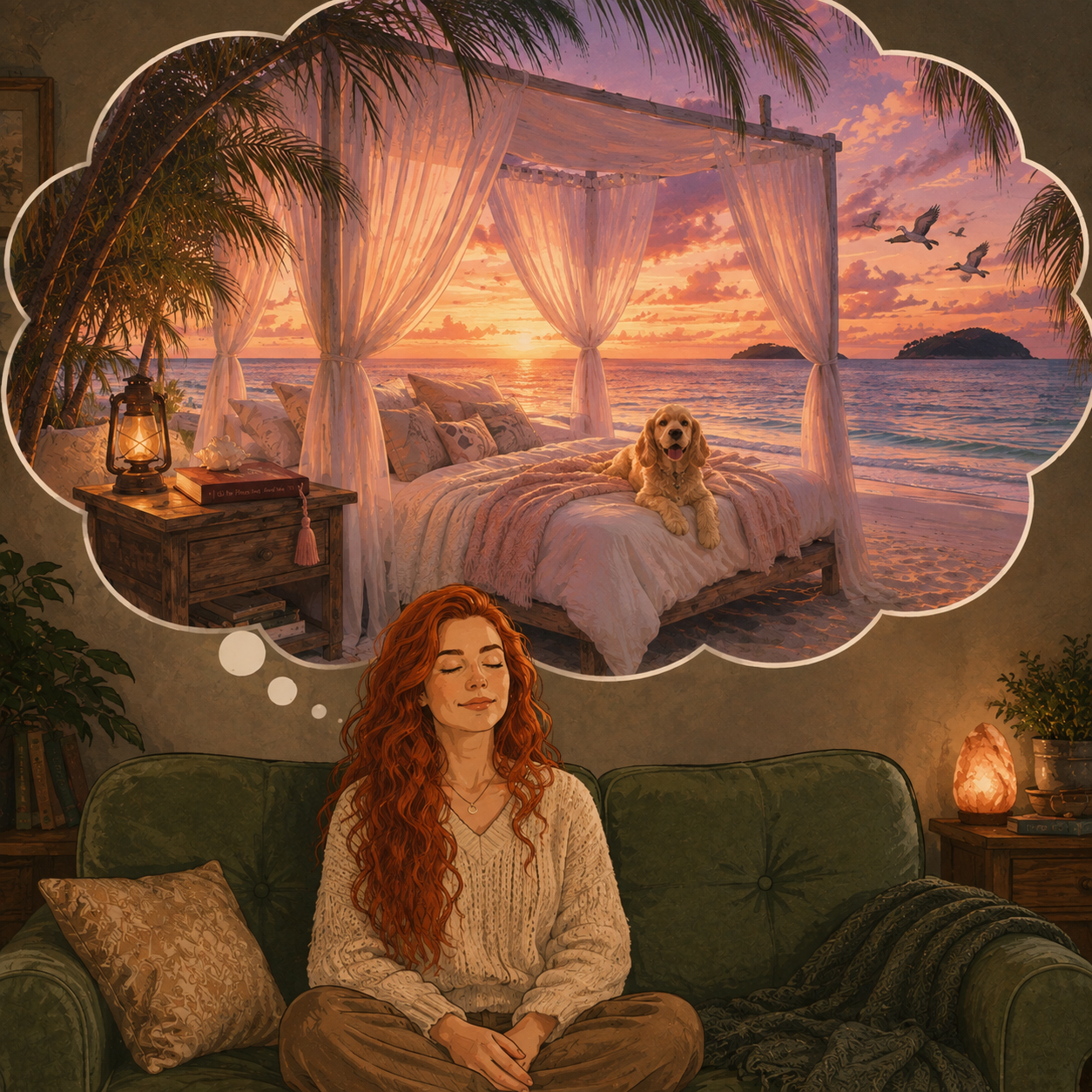
If your brain wants an old floral couch sitting beside a river beneath an enormous oak tree at golden hour, put that couch by the river, and settle in friend.
If you want a four-poster bed with clean white linens sitting directly on a secluded beach, POOF! Your imaginary beach now has a bedroom.

There are no zoning ordinances in your imagination!
The question isn't, "Would this work in real life?"
The question is:
"Does my nervous system like it here? Do I feel serene and safe here?"
That's why we build the place through more than just an image.
What can you hear?
What does the air smell like?
What can you feel against your skin?
Is it warm or cool?
Are you sitting, lying down, floating, swinging?
What are you wearing?
Is there something to drink or eat?
What time of day is it?
What time of year is it?
Are you protected from other people entering?
Is there a pet nearby?
Are there any comforting reminders around you?
Maybe there aren't any people there at all, but your grandmother's quilt is draped over the couch. Maybe there's a photograph on the nightstand. Maybe you have something that reminds you of someone you love without requiring that person to actually be present.
We're trying to give your brain as many ways as possible to access the experience. Attaching it to different parts of your brain keeps this tool alice and top of mind.
And that matters because a Peaceful Place isn't supposed to just be a pretty picture you can describe to your therapist.
It's supposed to produce a shift.
Maybe your shoulders drop.
Maybe your breathing changes.
Maybe your jaw unclenches.
Maybe your distress goes from a 4 to a 3.
That's still a shift.
We're teaching your brain: Oh. I know how to get here.
The Container: "This Matters, and I Don't Have to Carry It Right Now."

The Container serves a different purpose.
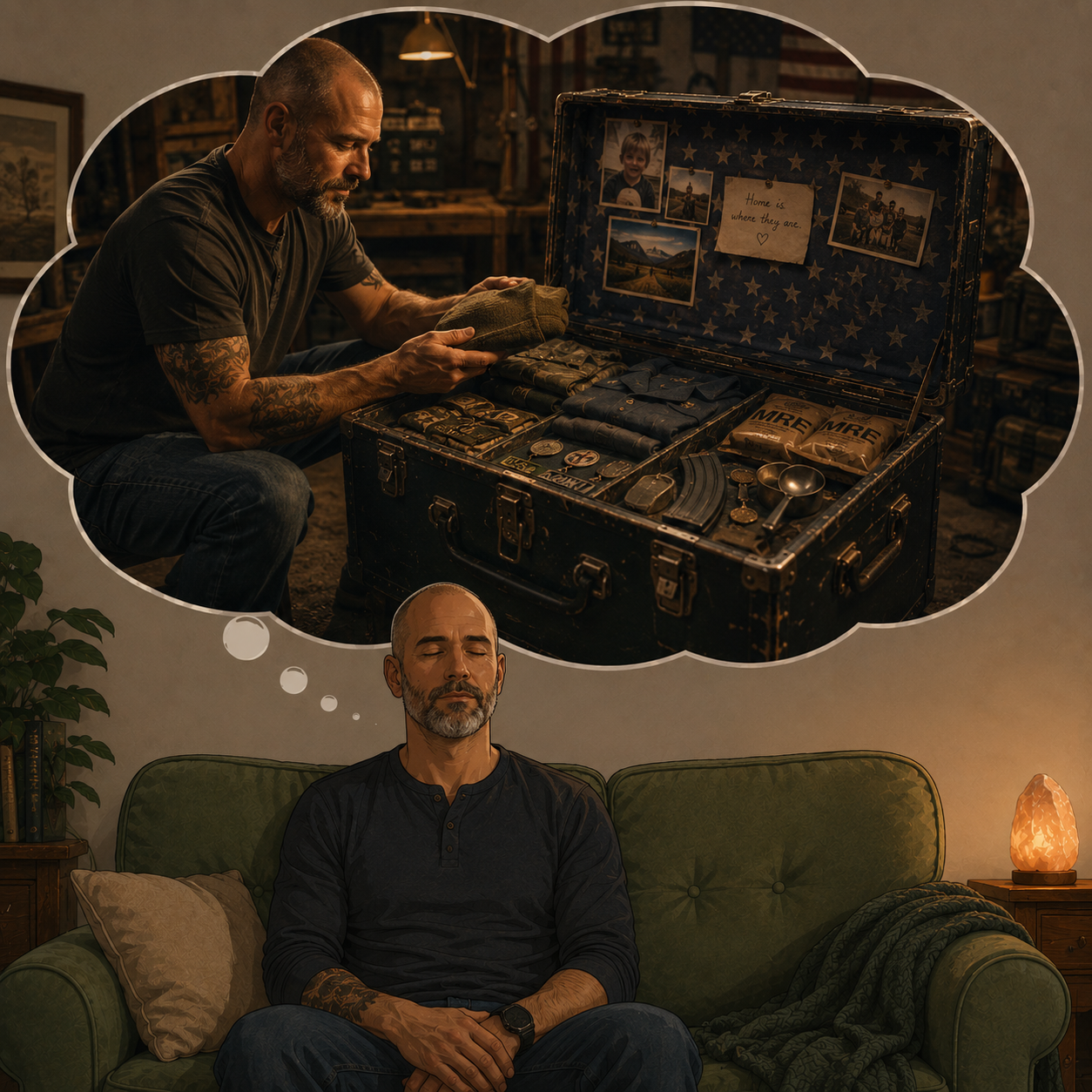
Sometimes something is important, painful, unresolved, or emotionally loud... and right now is still not the time to deal with it.
Maybe we reached the end of an EMDR session, and the processing isn't completely finished. Maybe something comes up while you're getting ready for work. Maybe you're trying to fall asleep, and your brain suddenly decides that 11:47 p.m. is an excellent time to revisit something from 1998.
The Container gives us another option besides:
Deal with this right now
or
Try desperately not to think about it. (a la: “don’t think about elephants”)
Instead:
"I'm not ignoring this. I'm putting it somewhere secure until I can come back to it."
The Container can look like practically anything.
A safe. A filing cabinet. A vault. A suitcase. A cave. A storage unit. A dishwasher. A treasure chest. A quadcon.
I've had heard all kinds of examples, such as difficult material becoming dirty dishes and the Container being an old dishwasher with a sliding latch.
Perfect.
Again: we're not grading this on realism.
We're asking whether your brain believes it, and can access the process of loading it into the container and feeling more at ease.
But! There are RULES for this one.
How to Build an EMDR Container: The Three Rules
When I help clients build one, I give them three rules.
1. It has to be big enough.
Whatever we need to put in there needs to fit.
2. It has to be comfortable enough inside.
This one gets interesting.
People sometimes tell me, "It's huge, so everything will be comfortable."
Not necessarily. Size tells me whether everything fits. Comfort tells me whether everything can settle.
Imagine putting everything you own into an enormous empty warehouse. Technically, there's plenty of room.
But things can still roll around, crash into one another, echo, overheat, freeze, get damaged, or pile up against the door. Anyone who has had a feral chaotic toddler with the run of the house can tell you, their home could be HUGE, and that little … darling… could make a mess in every single room! Whereas, if they have a comforting space, designated for them, they are more likely to be content hanging there.
Your Container may need shelves. Padding. Separate compartments. Ventilation. Organization. Whatever allows the contents to stay put without requiring your continued attention. To bounce back to the toddler reference (can you tell I have one at home?) like a playroom for the things that we have to put away for now until we have the appropriate bandwidth to deal with them.
And sometimes people object to this rule about comfort for an entirely different reason:
"I don't WANT that stuff to be comfortable."
Fair. I get that.
HOWEVER! Comfortable doesn't mean rewarded.
It doesn't mean forgiven, approved of, pampered, or given a tiny robe and cucumber water.
It means stable enough to remain contained.
You don't have to like the stuff you’ve got to put in there.
You just don't want to create conditions inside the Container that make your brain feel like it needs to keep monitoring what's happening.
and the final rule…
3. It has to close securely.
Latch. Lock. Valve. Combination. Zipper. Giant bank-vault wheel. Magical seal.
Whatever makes your brain go:
Yep. That's closed.
You also need to be able to open it again.
Because the Container isn’t a void, and it isn't where we throw things away.
It's where we put things until we're ready to come back.
"But If I Put It in the Container, Why Am I Still Thinking About It?"
This is one of my favorite questions because it gets at what containment actually means.
The Container does not turn your brain off.
It gives you permission to stop actively engaging with the material.
Your brain may still be doing things in the background.
After an EMDR processing session, you might notice a new connection while taking a shower. Something may suddenly make more sense the next morning. You may have a dream related to the work. You may feel tired afterward because you just asked your brain to do some pretty thorough labor.
None of that necessarily means your Container failed.
Think of closing a book after reading a really meaningful chapter. The book is closed, right?
But, you can still think about what you read.
Or think of it this way:
The Container is a bookmark, not a delete button.
It says:
This is where we stopped. I know where it is. I can return when I'm ready.
If something comes up between sessions, you don't necessarily have to chase it down and start processing it by yourself.
Notice it. Jot it down if you want to remember it.
And if it needs to go back in the Container until next time, put it there.
Why Practice With Something That Barely Bothers You?
After we build out these tools, the Peaceful Place and the Container, you will be asked to put them into practice using what we call a “rescript”. When we're first building these resources, I don't want you testing them on the worst thing that's ever happened to you. The stakes are a little high there for just a test run.
So, we're going to start ridiculously small.
Think 1 or 2 out of 10 distress.
The slow driver.
The mildly irritating email.
The thing you dropped after you had just gotten comfortable.
Something where you can genuinely say, "Ugh," rather than something that sends your whole nervous system into emergency mode.
We take that moment, and then we practice.
What would it have been like to have access to your Peaceful Place in that moment?
What happens if you imagine putting that irritation into your Container?
Does anything need adjusting?
Does the Container actually feel secure?
Does the Peaceful Place need another boundary?
Is the chair uncomfortable?
Is your imaginary beach inexplicably full of tourists?
Kick them out.
It's your beach!
Low-stakes practice gives us an opportunity to troubleshoot the tool before we ask it to do heavier work.
Can You Use EMDR Resources If You Can't Visualize?
YES! While some people have incredibly vivid mental imagery, others don't. That doesn’t mean the folks who don’t can’t access these tools.
You might experience your Peaceful Place as a feeling, a description, a collection of sensory impressions, a spatial awareness, like words on a page, or simply knowing what is there.
You can draw it. Write about it. Build a Pinterest moodboard. Choose a photograph. Imagine the sounds without seeing much of anything.
Know that there's a locked steel door without producing a crystal-clear mental image of the door.
We're not testing your imagination.
We're building access to a resource, that can be accessed in or out of the therapy room.
These Aren't Just EMDR Tools
One of the things I love about both of these resources is that they don't have to stay in the therapy room. When I work with a client to build out these tools, I send them off with the homework of putting these tools into practice between now and our next session. If you think of them, use them; if something comes up that’s suited for these tools, give it a shot. And I also make a point to emphasize that even though I am writing it out for my notes, I don’t own these tools, and the client is welcome to tweak and shift whatever they need or want to to make them best suited for their purpose so long as the rules are still adhered to for them.
The Peaceful Place can become something you access before a difficult conversation, to relax during a lunch break at work, while waiting for a medical appointment, after an overstimulating day, or while trying to settle down at bedtime.
The Container can help when your brain presents you with something important at a profoundly inconvenient time.
"Yes, this matters. No, we're not doing this while I'm driving."
Which is a useful skill whether you're doing EMDR or not.
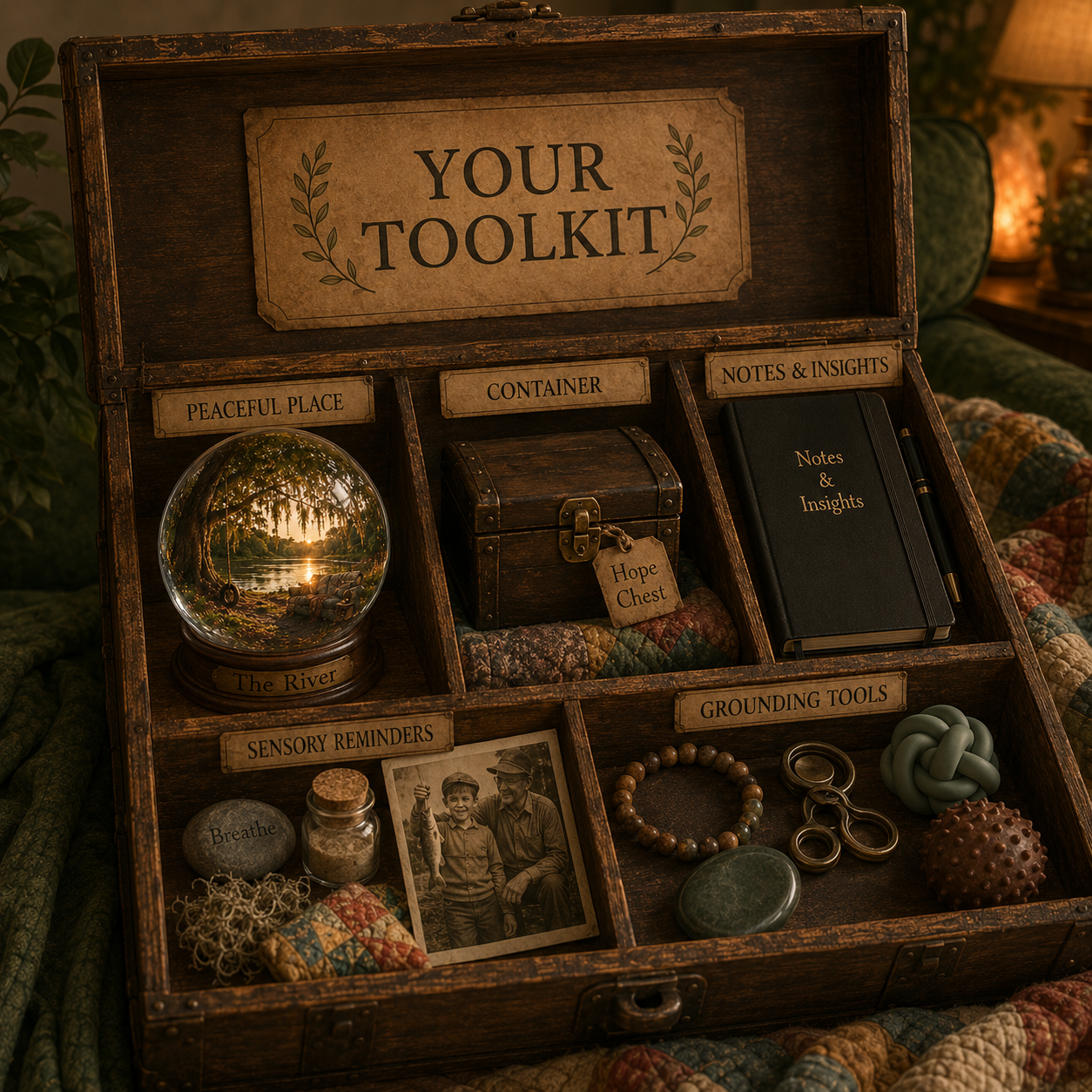
Over time, these resources can become part of a larger internal toolkit: ways you've practiced helping yourself move between activation and regulation, deciding when you're available for difficult material, and recognizing that something can matter without requiring your attention every second.
Want to Build Yours?
I've created a full EMDR Resource-Building Guide that walks you through creating both resources step by step.
We'll explore:
Your Peaceful Place through all five senses
Safety, security, comfort, and boundaries
Building and testing your Container
The three Container rules
Practicing both tools with low-level distress
Creating words, colors, symbols, and other retrieval cues
Troubleshooting when a resource doesn't quite work
What to do when you can't visualize
Why difficult material sometimes keeps processing after you've contained it
Ways to practice these resources outside the therapy room
One last reminder before you go exploring:
These are resources for regulation, containment, and preparation. They're not an invitation to pull up your most traumatic memories and see whether you can handle them on your own.
Start small. Build the tool. Learn what it feels like when it works.
Then, when there's heavier work to do, you and your therapist have already given your brain somewhere to put things down and somewhere peaceful to go.